It caught me off guard.
Last year, I experienced culture shock in Brazil—and honestly, I wasn’t expecting it.
It was my third visit to the country. I had traveled there extensively before, backpacking in different regions. I speak Portuguese well enough for daily life, and through the Brazilian martial art capoeira—which I have practiced for years—I have built many personal connections. I was convinced I already knew Brazilian culture. On top of that, as an intercultural consultant, I thought I would be well prepared for anything.
I went to Rio de Janeiro for a capoeira event and decided to stay in the Centro district for over a week. Although my Brazilian friends advised against it, I wanted to explore a different part of this vast city. Very close to Centro begins a favela, a slum district. Many homeless people lived on the streets, the atmosphere felt tense, and I had to be constantly alert about where I was walking. One block in the wrong direction and you could end up in a neighborhood where you might get into trouble. At night, loud music from bars filled my hotel room and disturbed my sleep.
After only a few days, I became sick. Even after returning home to Germany, I felt exhausted, depressed, and strangely unmotivated for weeks. I couldn’t understand what was happening—until I took the Deep Culture Masterclass.
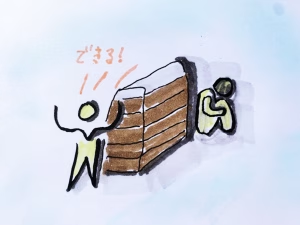
This course, led by Joseph Shaules from Keio University in Japan, introduced the Deep Culture Approach, which looks at culture through the lens of how the mind works. I learned that our brain usually runs on “autopilot,” guided by unconscious processes that make everyday life easy. In a foreign environment, this autopilot is constantly interrupted. Our cognitive mind has to work overtime to interpret unfamiliar signals, behaviors, and risks.
In Centro, my familiar mental patterns were confronted with a very different cultural reality. This constant mismatch overwhelmed my system and showed up as tiredness, illness, and low mood.
Foreign experiences are powerful, and culture shock is not a sign of weakness but a normal human reaction. Understanding this turned out to be an enormous gift for my future work in helping others navigate cultural challenges. After all, my culture shock became a gem.
And the biggest takeaway for me is simple: I now know that I don’t know—and that realization has fueled my curiosity to keep exploring culture and mind in depth.
Joseph Schaules is director of Japan Intercultural Institute (JII), a non-profit organzation supporting education, research and career development for intercultural professionals. Their Deep Culture Masterclass, which normally takes place virtually, is highly recommended. JII also produces an excellent podcast on Deep Culture.